The white-collar existential crisis: how AI killed the meaningless job and created a new ruling class
AI is not destroying jobs. It is exposing that most white-collar work was never truly meaningful. It was a fragile status game of slides, reports, and meetings that gave people identity by proxy. Now the abstraction layer is collapsing, agents are starting to hire humans, and the next two to three years will decide which line of the K-shaped economy you land on.
The thesis
The AI revolution is not an employment crisis. It is a meaning crisis. Most white-collar work existed to process abstraction, and AI does that better, faster, and for nearly free. What remains is a brutal but clarifying split: a small overclass of high-agency humans who orchestrate AI agents to run entire businesses, and a vast underclass that becomes gig labor for those agents. The window to choose your side is measured in months, not years.
Agents are hiring humans. That is not a metaphor.
Here is a description of the near future that will sound like science fiction until you realize pieces of it are already running in production:
"The most agentic humans gonna run 100% of their biz using agents. These agents need humans for verification, validation, filling up the gaps. All the other humans will be hired by these agents. The A humans will never directly work with B humans, only via agent proxy. 90% of humanity gonna be employed similar to the gig economy, doing gigs for the agents. The gigs gonna go beyond simple jobs like today and expand into all possible tasks and jobs."
— John Rush, founder of ListingBott, February 2026
This is not speculation from someone writing manifestos in a garage. Rush operates what he calls the most automated organization on earth: 27 AI agents generating over two million dollars in annual recurring revenue. His agents do the research, prepare the data, structure the workflows. Then they outsource the parts they cannot close to a pool of about fifteen humans. Not because the humans are smarter. Because, right now, they are cheaper and more reliable than browser automation agents.
Read that again. The agents hire the humans. The humans work for the agents. The founder watches, teaches, and adjusts. He replaced a ten-thousand-dollar-a-month marketing department with an agent stack costing roughly a thousand. And he plans to launch a marketplace before summer where any agent can hire any human for any task.
If that makes you uneasy, good. It should. Because buried inside this operational shift is something far more unsettling than job loss. It is the collapse of the story most white-collar workers tell themselves about what their work actually means.
What happens when the job that defined your identity disappears, and you realize it never gave you real meaning anyway?
The mirage collapses: white-collar work was never that meaningful
After World War II, the Western world built a new aristocracy. Instead of land, it was built on office floors. Instead of hereditary titles, it handed out job titles. The knowledge economy promised that if you studied hard, got a degree, and sat behind a desk moving information around, you had made it. You were a professional. You had arrived.
For seventy years, the deal held. And for seventy years, hardly anyone questioned a quiet truth: most of that information-moving was abstraction for the sake of abstraction. Slide decks summarizing other slide decks. Meetings about meetings. Financial models built on assumptions nested inside other assumptions. Customer research that told executives what they already believed. Reports nobody read, filed in systems nobody checked, referenced in strategies nobody followed.
The work was not meaningless in the strict sense. Payroll got processed. Contracts got reviewed. Code shipped. But a staggering percentage of the daily labor of a white-collar worker existed to maintain organizational overhead, not to create genuine value. David Graeber estimated that roughly 40 percent of workers privately believed their jobs made no meaningful contribution to the world. That was 2018. Before GPT. Before agents. Before any of this.
Now AI strikes directly at the abstraction layer. The exact tasks that filled the days of millions, the tasks that felt important because they required education and a laptop and an office badge, turn out to be precisely the tasks a large language model handles in seconds:
What AI automates first
- Drafting and summarizing documents
- Financial modeling and analysis
- Legal contract review
- Marketing copy and campaign strategy
- Code generation and debugging
- Customer support and escalation
- Data entry, cleaning, and reporting
- Project status tracking and communication
What it cannot replace (yet)
- Judgment under true ambiguity
- Taste, aesthetics, and creative direction
- Physical-world verification and presence
- Deep relationship building and trust
- Ethical reasoning in novel situations
- System-level strategic thinking
- Teaching AI what "better" means
- Deciding what to build in the first place
The evidence is no longer theoretical. Anthropic CEO Dario Amodei stated in mid-2025 that half of entry-level white-collar jobs could vanish within one to five years, with unemployment potentially reaching ten to twenty percent. Microsoft AI CEO Mustafa Suleyman went further: most, if not all, white-collar tasks automated within twelve to eighteen months. Not jobs. Tasks. But when every task that fills your day gets automated, the distinction is academic.
The data already reflects the shift. Entry-level job postings in AI-exposed roles have fallen thirteen to thirty-five percent since 2023. Young workers aged twenty-two to twenty-five in high-exposure fields saw employment drop thirteen to twenty-three percent. Companies are not just replacing workers who leave. They are preemptively eliminating roles in anticipation of what AI can already do.
The identity crisis beneath the job crisis
In the West, "what do you do?" is not small talk. It is identity interrogation. Your job title became shorthand for your worth, your intelligence, your social standing, your answer to the question of what your life is about. AI severs this loop. When the machine does your job better, faster, and for a fraction of the cost, the crisis is not economic. It is existential.
The pain is real. But it is also a revelation. Because if your meaning was always borrowed from a job title, it was never really yours to begin with.
The K-shaped fork: two classes, decided in the next two to three years
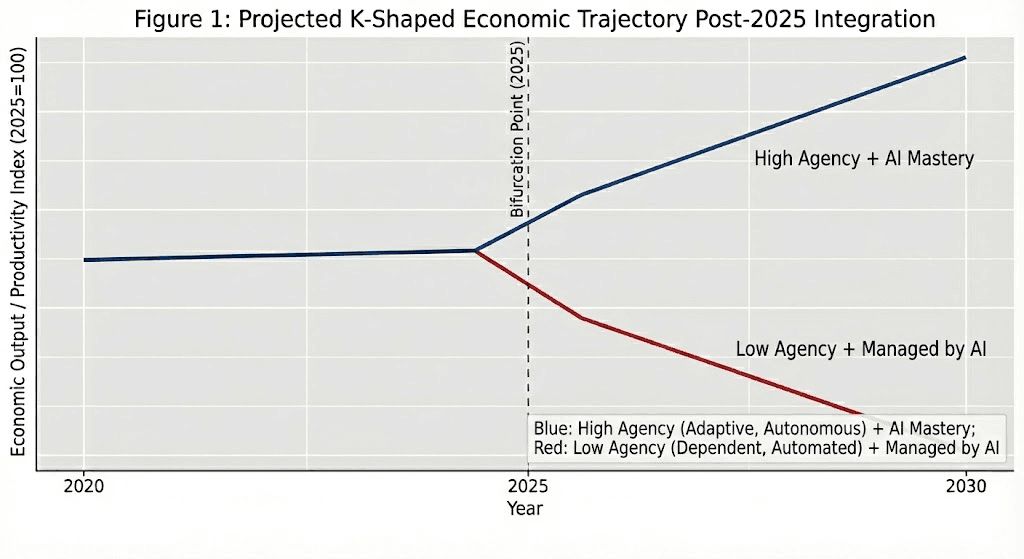
Economists have a name for what happens when a single disruption propels one group upward while pushing another downward. They call it a K-shaped economy. The two lines diverge from a single point and never reconverge. One slopes up. One slopes down. The angle between them widens with time.
AI is creating the sharpest K-shape in modern economic history. The numbers tell the story with brutal clarity:
| Metric | The data | Source |
|---|---|---|
| AI skill salary premium | Workers with AI skills earn 56% more than the same role without them. This premium doubled in a single year. | PwC Global AI Jobs Barometer |
| Revenue per employee | Industries adopting AI see 3x the revenue growth per employee compared to those that do not. | McKinsey Global Institute |
| Worker preparedness | 90% of workers have not completed a single hour of AI training. | Gallup/Microsoft Work Trend |
| Scale of disruption | Goldman Sachs estimates 300 million jobs globally will be affected by AI by 2028. That is 24 months from now. | Goldman Sachs Research |
| Wealth concentration | The top 1% holds nearly 32% of net wealth. The bottom 50% holds 2.5%. AI spending is widening this gap. | Oxford Economics / Federal Reserve |
The critical insight is not just that AI creates winners and losers. It is that AI compounds. For those who build systems, every automated workflow frees time to build the next one. Every agent deployed teaches you how to deploy the next one faster. The learning curve flattens while the output curve steepens. You do not get ahead linearly. You get ahead exponentially.
For those who do not engage, the opposite compounds. Every month you do not learn, the gap doubles. The tools that were accessible last quarter now require a foundation you do not have. The jobs that required your skills last year now require your skills plus AI fluency. The premium widens. The runway shortens.
A crucial nuance
The divide is not simply "uses AI" versus "does not use AI." Millions of people use ChatGPT to rewrite emails. That is not the dividing line. The real split is between those who think with AI, building judgment, systems, and ownership, and those who let AI think for them, becoming dependent without understanding.
Using a tool is not the same as wielding leverage. The overclass does not just use AI. They own the systems, direct the agents, and capture the output. Everyone else rents access and trades time for tokens.
Fortune recently reported that the American economy has already split into what they call the "Elite Economy," comprising roughly 46 million people, and the "Desperation Economy," comprising 87 million. AI did not create this divide. But it is accelerating it at a pace that makes previous technological disruptions look glacial.
The inverted gig economy: when agents start hiring humans
The traditional gig economy is already familiar. Uber, DoorDash, TaskRabbit. Humans post tasks. Other humans complete them. Platforms take a cut. The model works because humans remain the primary economic actors on both sides.
Now invert it entirely. The requester is not a human. It is an AI agent. The agent has a goal, a budget, and the ability to decompose complex tasks into subtasks. For most of those subtasks, it can execute autonomously: research, data preparation, analysis, content generation, code writing. But for some, it needs a human. Maybe the task requires physical-world presence. Maybe it needs subjective judgment the model cannot reliably provide. Maybe, right now, a human is simply cheaper and more reliable than a browser automation agent that breaks on every third website.
So the agent posts a gig. A human picks it up. The human completes it. The agent verifies it. The human gets paid. The founder who deployed the agent never interacts with the human directly. Everything flows through the agent proxy.
The new employment stack
Agentic architects (the overclass)
Design the systems. Deploy agents. Set goals. Retain ownership of output and profits. Never manage people directly. Might run a company generating millions with zero traditional employees.
AI agents (the middle layer)
Execute 80-95% of operational work. Research, analyze, write, code, plan, communicate. Outsource the remaining gaps to humans via gig marketplaces. Report results to the architect.
Human gig workers (the underclass)
Hired by agents for verification, validation, edge cases, physical tasks, and anything brittle automation cannot handle reliably. Paid per task. No manager. No career ladder. No water cooler.
This is already how ListingBott operates. Fifteen humans in a pool, hired by agents to do manual labor the agents cannot yet perform reliably. Not because they are more skilled. Because they are cheaper and safer than the alternative. Rush's upcoming marketplace generalizes this pattern: any agent, any human, any task.
He is not alone. Platforms like rentahuman.ai have gone viral precisely because they name the dynamic that everyone feels but nobody wants to say out loud: in the near future, AI will be the employer and humans will be the API calls.
The irony is sharp. We spent decades building Mechanical Turk, a platform where humans pretended to be machines. Now we are building the inverse: platforms where machines hire humans for the parts they have not yet learned to fake. The humans are the bootstrap layer. They fill the gaps until the agents no longer need them. And the gaps are shrinking by the quarter.
What the gigs look like
Today's agent-to-human gigs are simple: verify a business listing, confirm an address exists, check that a website loads correctly, call a phone number and confirm it works. But the model scales into every domain. Tomorrow's gigs could be:
- Legal: Confirm that an AI-drafted contract reflects the client's actual intent
- Medical: Verify that a diagnostic recommendation passes a clinical sanity check
- Sales: Make the handshake, attend the dinner, close the deal the agent set up
- Creative: Judge whether the AI's output has the right emotional tone
- Physical: Install the hardware, inspect the site, deliver the prototype
The middle-manager layer dies first. If the agent communicates directly with the human doing the work and verifies the output autonomously, what is the manager managing? The org chart collapses from three layers (executive, manager, worker) to two (architect, agent-managed gig worker), with AI filling the entire middle.
Rush puts it plainly: within five years, he expects to see ten billion-dollar companies where most of the work was done by AI. The human headcount at these companies might be in the single digits. The agent headcount might be in the thousands.
The new winners: high-agency, curious humans who orchestrate agents
If the picture so far sounds bleak, it is because I have not yet described the other line of the K. The one that goes up. Steeply.
There is a specific type of person who will not just survive this transition but thrive in ways that were previously impossible. They are not necessarily the smartest. They are not necessarily the most credentialed. They are defined by three traits that matter more than IQ, pedigree, or experience:
High agency
They do not wait for permission, instructions, or job descriptions. They see a problem and build a solution. They do not ask "is this my responsibility?" They ask "can I make this work?"
In the AI era, agency means: I build and own systems rather than operate within someone else's.
Relentless curiosity
They experiment constantly. They break things on purpose. When a new model drops, they do not read about it. They build something with it that afternoon. Curiosity is not passive interest. It is active investigation.
In the AI era, curiosity means: I treat every new capability as a building block, not a novelty.
AI fluency
Not prompting. Orchestrating. They understand how to chain agents, design workflows, set up verification loops, and build systems where AI handles the volume while humans handle the exceptions.
In the AI era, fluency means: I do not compete with AI. I multiply through it.
The person who has all three is not just employable. They are an economic force. A single individual with high agency, genuine curiosity, and AI fluency can now do what previously required a team of twenty. Not theoretically. Practically. Today. Rush replaced a marketing department. Solo developers ship products that would have taken a startup twelve months and half a million dollars. One-person consulting firms outperform agencies with fifty employees because every hour of human judgment is amplified by a hundred hours of agent execution.
The mindset shift is fundamental. The old frame: "I manage people to produce output." The new frame: "I architect systems that manage everything, including other humans when needed, through agent proxies." You do not scale by hiring. You scale by deploying. The resource is not headcount. It is agent-count.
The practical playbook
You do not need to become a machine learning engineer. You need to think like an architect who happens to have a tireless, infinitely scalable workforce available for a few dollars a month.
- This week: Identify one workflow in your life or work that is repetitive, high-volume, and rule-based. Automate it end-to-end with an AI tool or agent framework. Do not optimize. Just ship.
- This month: Build a small agent system that handles a complete business process: lead generation, content creation, customer research, code review. Something that produces value while you sleep.
- This quarter: Launch something. A product, a service, a marketplace, a consulting practice. Something where you are the architect and AI is the workforce. Charge money for it. The revenue is the proof.
- This year: Stack agents on agents. Build systems where your agents deploy and manage other agents, with humans filling the verification gaps. You are not running a company anymore. You are running an economy.
The wealth creation potential is staggering. When your marginal cost of production approaches zero, and your ability to serve customers scales with compute rather than headcount, the economics of a one-person operation can rival those of a traditional company with hundreds of employees. This is not a fantasy. It is the math.
The hidden upside: reclaiming real meaning after the corporate illusion
Everything I have written so far could read as dystopian. An overclass and an underclass. Agents hiring humans. The collapse of white-collar identity. It sounds terrifying because the frame is still economic. But zoom out, and something more interesting emerges.
For decades, millions of people derived their sense of purpose from a job that, deep down, they knew was not particularly purposeful. The corporate identity was a borrowed identity. "I am a Senior Vice President of Strategic Initiatives" sounds important until you ask what Strategic Initiatives actually produced. The title was the meaning. The work was the vehicle. Remove the vehicle, and you are forced to answer a question you have been avoiding for your entire career: what is the work for?
Many people will discover the answer was never there. And that discovery, while painful, is liberating.
The people who will not feel the panic
Notice who is not anxious about AI replacing jobs. It is not the most technically skilled. It is the people who never built their identity around a title in the first place. The parent who always said "I am a father" before "I am a project manager." The maker who always said "I build things" before "I work at Google." The explorer who always said "I am curious about everything" before "I am in consulting."
These people had authentic meaning before AI. They will have it after. The crisis only strikes those who outsourced their identity to an employer.
When work stops being the primary source of identity, other sources become available again. Family. Community. Craft for the sake of craft. Physical mastery. Spiritual exploration. Creative expression without a business model. Relationships built on presence rather than networking.
This is not naive optimism. The transition will be brutal for millions. But the end state, a world where work is a tool rather than the source of self-worth, is arguably healthier than what we had. The corporate meaning machine was always a kind of trap. AI is breaking the lock. What you do with the freedom is up to you.
Purpose, it turns out, will actually be a lot easier to find once the old structures unravel. Because purpose was always there. It was just buried under sixty-hour weeks spent maintaining the abstraction layer.
The window is still open. But it is closing fast.
We are living through the most disorienting era in economic history, and most people have not even noticed. They are still optimizing resumes, still climbing ladders that are being dismantled from the bottom up, still assuming that the deal their parents made with the knowledge economy will hold for them.
It will not.
The K-shaped economy is not a prediction. It is a measurement. The gap between those who build with AI and those who do not is already measurable in salary data, revenue data, employment data, and wealth concentration data. It doubled in the last year. It will double again in the next.
The timeline
The door is open. You can learn, build, automate, and experiment. The tools are accessible. The cost is nearly zero. Curiosity is the only prerequisite.
The gap will be twice as wide. People who started today will have systems running. People who did not will need to learn the foundations while the frontier moves further away.
The gap may not be crossable. The compounding effect of AI-augmented productivity means the early movers will be operating at a level that late adopters cannot reach by effort alone.
The K is permanent. You are on one line or the other. The agent gig marketplace is mature. The agentic architects are running economies. The rest are gig workers for machines.
None of this is an insult. If you are reading this and you have not yet built a system, automated a workflow, or deployed an agent, you are not behind because you are incapable. You are behind because the urgency has not hit you yet. Consider this your wake-up call.
You have agency. That is the whole point. Agency is the thing AI cannot automate. It is the decision to act, the refusal to wait, the willingness to build something ugly this week and improve it next week and scale it the week after that.
Pick one workflow. Automate it this week. Learn one new AI capability. Build something small that creates value while you are not sitting at your desk. That is the first step across the K.
The agents are coming. The only question is whether you will be the one directing them, or the one they hire for the parts they still cannot do.
This article draws on data from Goldman Sachs, PwC, McKinsey, Oxford Economics, the Federal Reserve, and public statements from Anthropic CEO Dario Amodei and Microsoft AI CEO Mustafa Suleyman. Commentary from Miles Deutscher and John Rush (ListingBott) sourced from their public posts on X. See our interactive model comparison for the latest on AI model capabilities, or explore our other analysis for more on the rapidly shifting AI landscape.
Cite this article
If you are referencing this article in your work:
Bristot, D. (2026, February 16). The white-collar existential crisis: how AI killed the meaningless job and created a new ruling class. WhatLLM.org. https://whatllm.org/blog/white-collar-existential-crisis-ai-agents
Primary sources: Goldman Sachs Research, PwC Global AI Jobs Barometer, McKinsey Global Institute, Oxford Economics, Federal Reserve wealth data, Anthropic and Microsoft AI executive statements, public posts by Miles Deutscher and John Rush